As the Liga BetPlay DIMAYOR I-2026 enters its decisive “Todos contra Todos” phase, the headlines are increasingly dominated not by spectacular goals or tactical masterclasses, but by a deepening crisis in officiating. Despite the implementation of Video Assistant Referee (VAR) technology intended to minimize human error, the consensus among experts, coaches, and former referees is clear: Colombian officiating is traversing one of the most turbulent and lowest-quality periods in its history.
From inexplicable interpretations of handballs to a perceived over-reliance on VAR that undermines on-field authority, the “whistle” in Colombia has become a source of constant friction. The following report examines the systemic failures, expert critiques, and recent controversies that have placed the Arbitral Commission of the Colombian Football Federation (FCF) under an unprecedented microscope.
1. A Pattern of Error: High-Profile Controversies in 2026
The first semester of 2026 has been marred by a series of officiating blunders that have directly impacted match results and the league standings. Experts point to a lack of uniform criteria as the primary culprit.
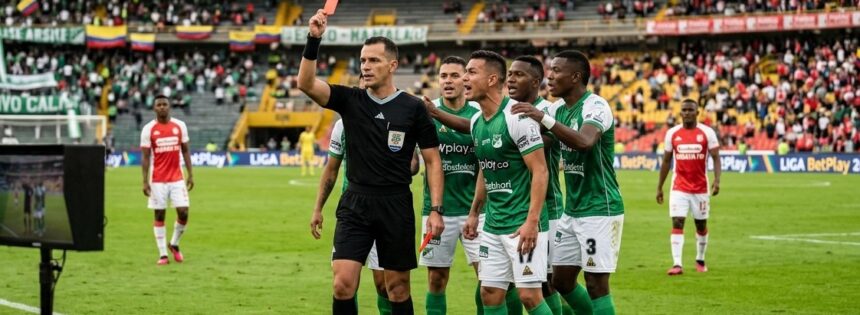
- The Interpretation Gap: One of the most glaring errors occurred during the Deportivo Cali vs. Deportivo Pasto match in February. Referee Jairo Mayorga, following a VAR call, incorrectly annulled a goal for Cali and issued a red card to player Gil. According to renowned analyst José Borda, the VAR intervention violated the protocol since the play had already been restarted; the goal should have stood.
- The “Double Rhythm” Debate: In the high-stakes clash between Independiente Santa Fe and Junior FC at El Campín, FIFA referee Wilmar Roldán—traditionally considered the gold standard in Colombia—found himself at the center of a storm. Roldán initially dismissed a penalty claim against Santa Fe goalkeeper Mosquera Marmolejo. However, after a VAR intervention, he reversed his decision and awarded a penalty to Junior. Analysts from the account “El VAR Central” noted that while the contact was reckless, it sparked a nationwide debate on the “biomechanics” of goalkeepers and whether technology is over-policing natural movements.
- The Time Management Chaos: During a match between Junior and América de Cali, technical director David González publicly voiced his frustration over the confusion regarding added time. “None of the officiating crew took responsibility for the calculation,” he stated, highlighting a lack of basic administrative control on the pitch.
2. Expert Consensus: “The Worst Moment in History”
The criticism is not limited to angry fans on social media. Former referees and international analysts have been scathing in their assessment of the current state of the FPC (Fútbol Profesional Colombiano).
José Borda, an analyst for Caracol Radio and one of the most respected voices in the field, has consistently pointed out that “even with the VAR tool, more mistakes are being made than expected.” He argues that the technology has become a “crutch” for referees who lack the confidence to make decisive calls in real-time, leading to a loss of natural flow in the game.
Similarly, former referee Wilmer Barahona has been a vocal critic of the current leadership. The debate reached a fever pitch in March 2026 when Imer Machado, Director of the Arbitral Commission, faced allegations regarding the integrity of the referee selection process. While Machado has met with FCF President Ramón Jesurún to evaluate legal action against these accusations, the mere existence of such “corruption” narratives has severely damaged the public’s trust in the institution.
3. Structural Failures and “Physical Fitness” Alarms
Beyond tactical and technical errors, there are concerns about the physical and professional preparation of Colombian referees.
At the beginning of the 2026 season, a significant number of officials failed the mandatory physical tests conducted in Bogotá. The FCF cited the 2,600-meter altitude as a mitigating factor, but critics argue this is a symptom of a deeper lack of professionalization. If referees are not in peak physical condition, their cognitive performance—and thus their decision-making under pressure—is inevitably compromised.
Furthermore, there is a perceived “protectionist” culture within the Commission. Experts argue that when a referee makes a blatant error, they are often sanctioned with a few weeks of “rest” only to return to a high-profile match shortly after, without any public explanation of the corrective measures taken.
4. The Path Forward: Can Trust Be Restored?
The current state of the Liga BetPlay suggests that technology alone is not a panacea. For the second semester of 2026 and the upcoming 2027 cycle, several experts suggest a radical shift:
- Transparency in VAR Audios: While the FCF has begun releasing some VAR audios, experts demand a more consistent and real-time socialisation of the decision-making process to educate the public and hold officials accountable.
- External Audits: There are calls for an independent review of the Arbitral Commission’s hierarchy to ensure that appointments are based strictly on merit rather than political or regional affiliations.
- Enhanced Professionalization: Moving away from a “weekend hobbyist” model to a full-time, high-performance professional career for referees, including psychological support and constant technical training.
The Colombian league remains one of the most competitive and passionate in the Americas. However, until the “men in black” can match the level of the players and the expectations of the fans, the shadow of doubt will continue to loom over every goal and every final whistle.